An Introduction to Mugwort
The Snow Moon — January 18 through February 16, 2026
Known in Hermetic tradition as the Seed Moon: Nigredo, inward listening, descent
January 13, 2026
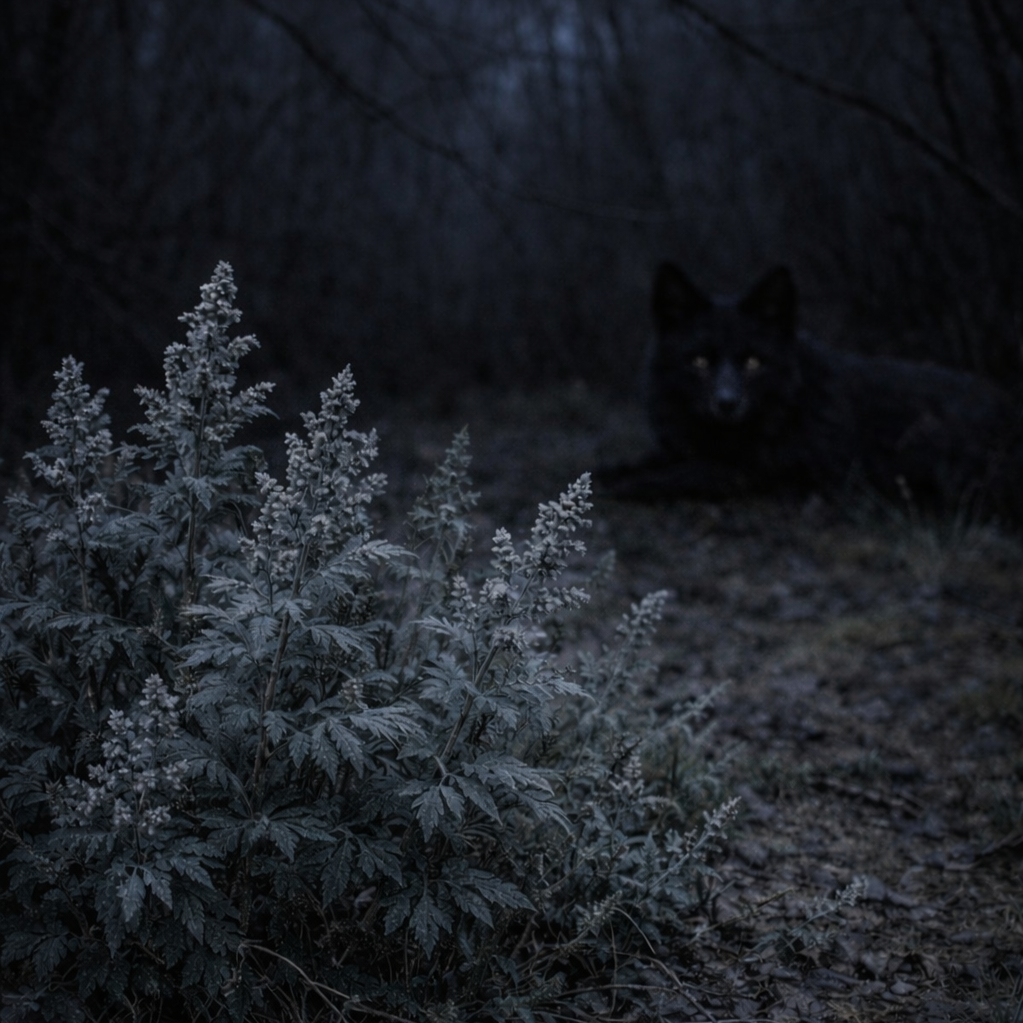
There is a quiet that settles in the depth of winter that is not empty.
The Hermetic tradition names this moon the Seed Moon — the first arc of the alchemical year, the stage of Nigredo, the blackening. Not death, but the condition that precedes emergence. The seed does not struggle in the dark. It listens. It gathers. It waits with a kind of intelligence that has no use for hurry.
The Snow Moon asks the same of us. Movement slows to what is essential. Perception sharpens in the cold. And into this particular quality of dark, one plant steps forward with unmistakable authority.
Mugwort has always known how to move in the dark.
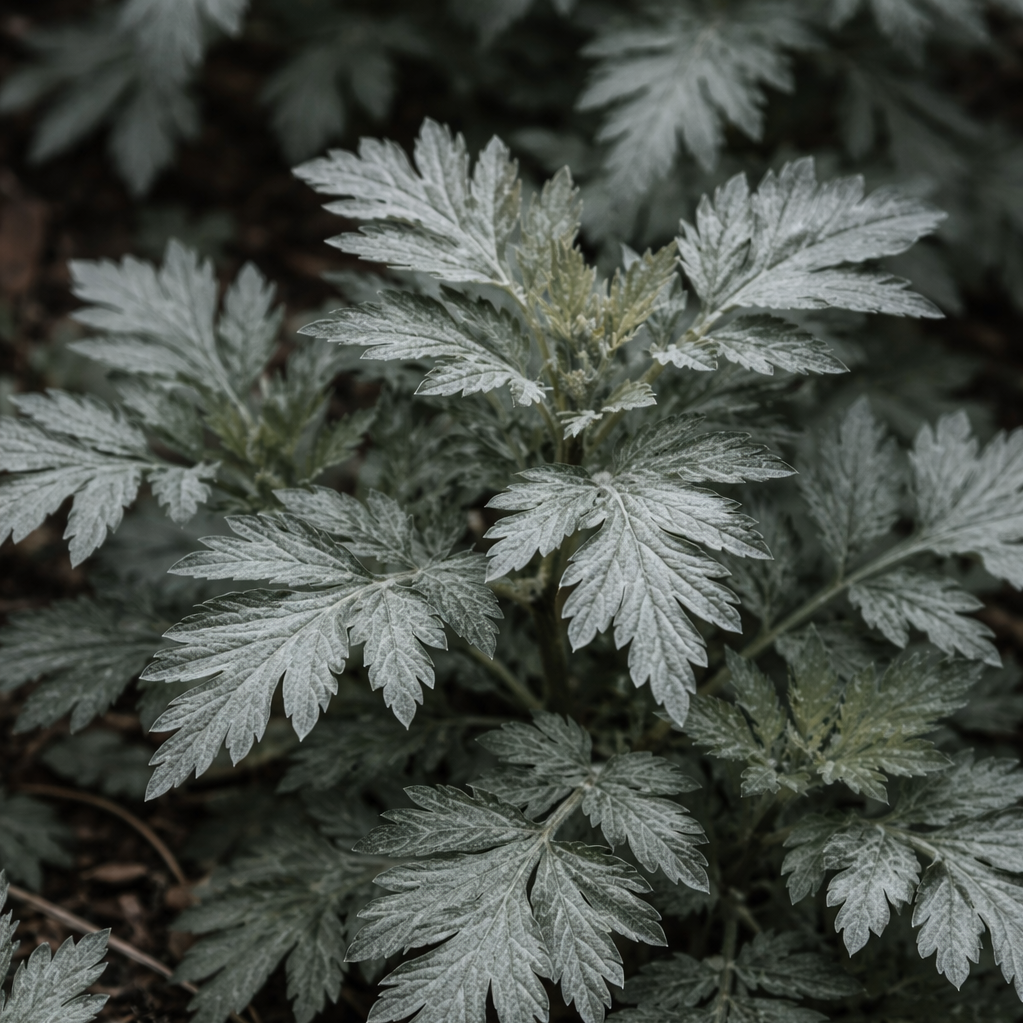
Artemisia vulgaris — Common Mugwort, Cronewort, Sailor's Tobacco, Felon Herb. She is a plant of ancient and continuous relationship with human beings, found in the hedgerows of Britain, the roadsides of Europe and Asia, the waste places and field margins that most people walk past without looking twice. She is not rare or precious in the way that drives collectors. She grows exactly where she wants to, in the in-between places, along the edges of things.
Her genus name, Artemisia, is the botanical inheritance of Artemis — goddess of the moon, the hunt, and the threshold between wildness and civilization. Her folk names are equally revealing. Cronewort names her as a plant of elder wisdom and elder women, of the crone phase that neither apologizes nor explains. Felon Herb names her protective character — historically used to ward off malevolent forces, misfortune, and the kind of spiritual corruption that was once taken as seriously as physical illness.
She is a tall, rangy plant with deeply lobed, dark green leaves that are silver-white on the underside — that pale underbelly catching light like the moon itself reflected on still water. Her smell is what most people remember: warm, camphorous, bitter-green, slightly resinous. Distinctly herself. Once you know Mugwort by scent, you do not confuse her with anything else.
She is a member of the Asteraceae family, kin to Wormwood, Yarrow, and Elecampane — a lineage of aromatic, bitter, boundary-setting plants. She shares with them a kind of directness. These are not gentle, self-effacing herbs. They have an opinion. They hold a line.
Mugwort is most widely known for dreamwork, and that reputation is earned — but it tells only part of her story. To reduce her to a dream herb is to miss the pattern that makes her a dream herb, and that pattern runs through everything she does.
At her core, Mugwort is an herb of movement and perception. She disperses what has grown stagnant and clarifies what has grown murky. This is true at every level: in the blood, in the uterus, in the nervous system, in the dreaming mind. The thread connecting all her actions is the same — she keeps things from congealing, from thickening into obstruction, from going underground in ways that serve no one.
As a nervine and aromatic bitter, she engages the nervous system with warmth and dispersive energy. She is not a sedative in the way of Valerian or Passionflower, not primarily a relaxant. Her action is more subtle: she attunes. She quiets the surface noise of the mind while amplifying the signal beneath it — the body's own intelligence, the dream layer, the intuitive register that most of us are too busy to hear during waking hours. This is the quality that makes her a threshold herb. She does not force entry into altered states; she opens the perceptual doors that were already there.
In womb work, she has a long history as an emmenagogue — an herb that stimulates and regulates menstrual flow. She is warming and moving to the uterus, traditionally employed when the cycle has become sluggish, delayed, or painful from cold and stagnation. This is skilled territory and not casual territory; an herb that moves what has been held carries both power and responsibility. But her affinity for the womb is part of the same pattern: she does not allow the vital to pool and stagnate. She circulates.
As a dream ally, she works through all of the above. When the nervous system is attuned rather than numbed, when the blood and lymph are moving rather than congested, when the body is warm and the mind is quiet but alert — this is the condition in which dreaming deepens. Mugwort does not conjure visions from nothing. She cultivates the conditions in which the dreaming mind can do its own work, more vividly and with greater recall.
I have worked with her in sleep for years — a cup of mild tea taken in the quiet of the evening, or a small amount of dried herb burned in a bowl by the bed before sleep. What I notice is not strangeness but clarity. Dreams become more narrative, more available to the waking mind upon return. The threshold between sleep and waking grows more permeable, in the best sense: information moves across it more freely in both directions.
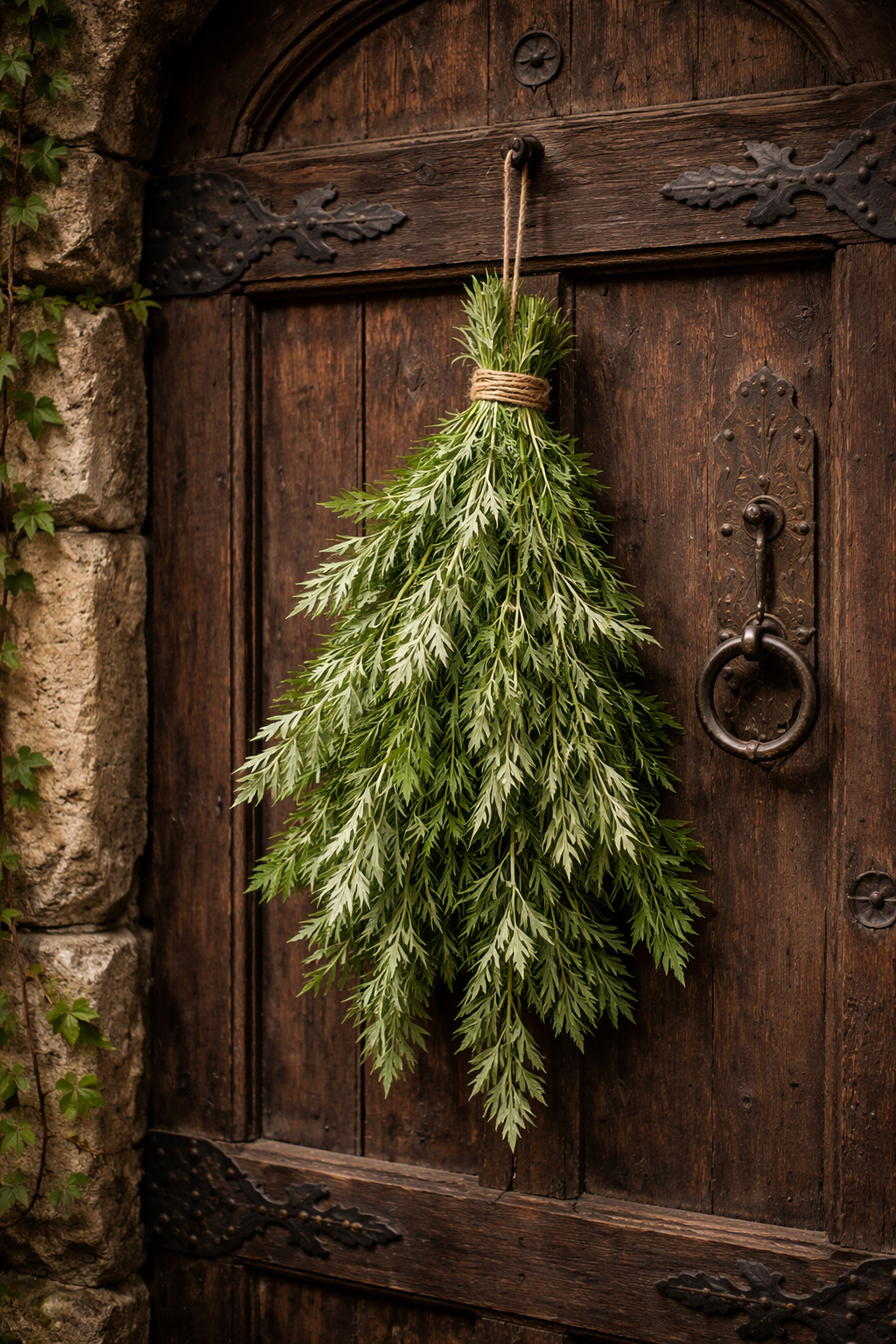
Every spring, I hang Mugwort at my front door.
This is a Druidic practice, and a seasonal one, and the two cannot be separated. The door is a threshold — the boundary between inside and outside, between the held space of home and everything beyond it. Threshold magic is old magic, found in nearly every culture that has thought seriously about the relationship between protection and place. You hang a guardian at the threshold not because the world is malevolent, but because the boundary deserves intention.
Mugwort is the right plant for this work. Her protective character is part of her fundamental nature — the Felon Herb, the warding plant, the one that keeps the field clear. As the year turns from winter's contraction toward spring's expansion, as the door begins to open more often and the world begins to press back in, she stands at the entrance and holds the integrity of the space. I sometimes weave her into a wreath, a form that has its own long Druidic history — the circle, unbroken, continuous, a statement of wholeness. Other times I simply bundle her and hang her without ceremony beyond the act of hanging, which is ceremony enough.
It is a gesture I return to every year without question. Some practices earn their permanence through feeling rather than argument.
The Snow Moon is exactly the right time to begin a relationship with Mugwort, or to deepen one already underway.
The Seed Moon of Hermetic tradition — this first arc of the alchemical year, governed by the Moon herself — is a time for descent and inward listening. For sitting with what is not yet formed. For the kind of perception that precedes language. These are precisely the conditions Mugwort works within and supports. She is a plant who has always been at home in the dark, in the threshold, in the space between waking and sleep, between one season and the next, between the known and whatever gathers at the edge of it.
Begin simply, if you are new to her. A cup of tea — a small pinch of dried herb, steeped covered for ten minutes to preserve the volatile oils, drunk in the quiet of the evening. Keep a journal beside the bed. Do not demand anything from the dreams. Simply be present to them.
If you work with smoke, burn a small amount of dried Mugwort in a bowl by the bed before sleep or as part of an evening ritual. Her scent alone is a kind of tuning — a signal to the body that the mode is shifting, that perception is being invited to do something different.
If she grows near you, or if you keep her in your apothecary, take a moment now, in this dark moon, to hold her in your hands and simply attend. The Vitalist approach to plant medicine begins in relationship, and relationship begins in attention.
The Snow Moon will not wait. But Mugwort is patient. She grows in the margins and she meets you where you are.
In devotion,
Alexandra Regina
Black Fox Lunar Apothecary
Vitalist Herbal Practitioner