Mugwort in Practice: Formulation, Constitution, and Application
Snow Moon also known in Hermetic tradition as the Seed Moon
January 25,2026
Mugwort
Mugwort is commonly associated with dreaming, but her medicinal value extends well beyond that single domain. She is an herb that moves nervous system states, engages circulation, and participates in threshold experiences—physiological, psychological, and symbolic. To understand Mugwort as medicine is to understand her pattern rather than her reputation.
In Vitalist Herbal Practice, herbs are understood through their full energetic and relational profile. Every herb carries an energetic signature—hot or cool, damp or dry, stimulating or relaxing—and a set of affinities that shape how it interacts with the human body. Mugwort’s influence becomes visible not when she is assigned to a condition, but when her qualities are matched to a person’s constitution, tissue state, and moment in time.
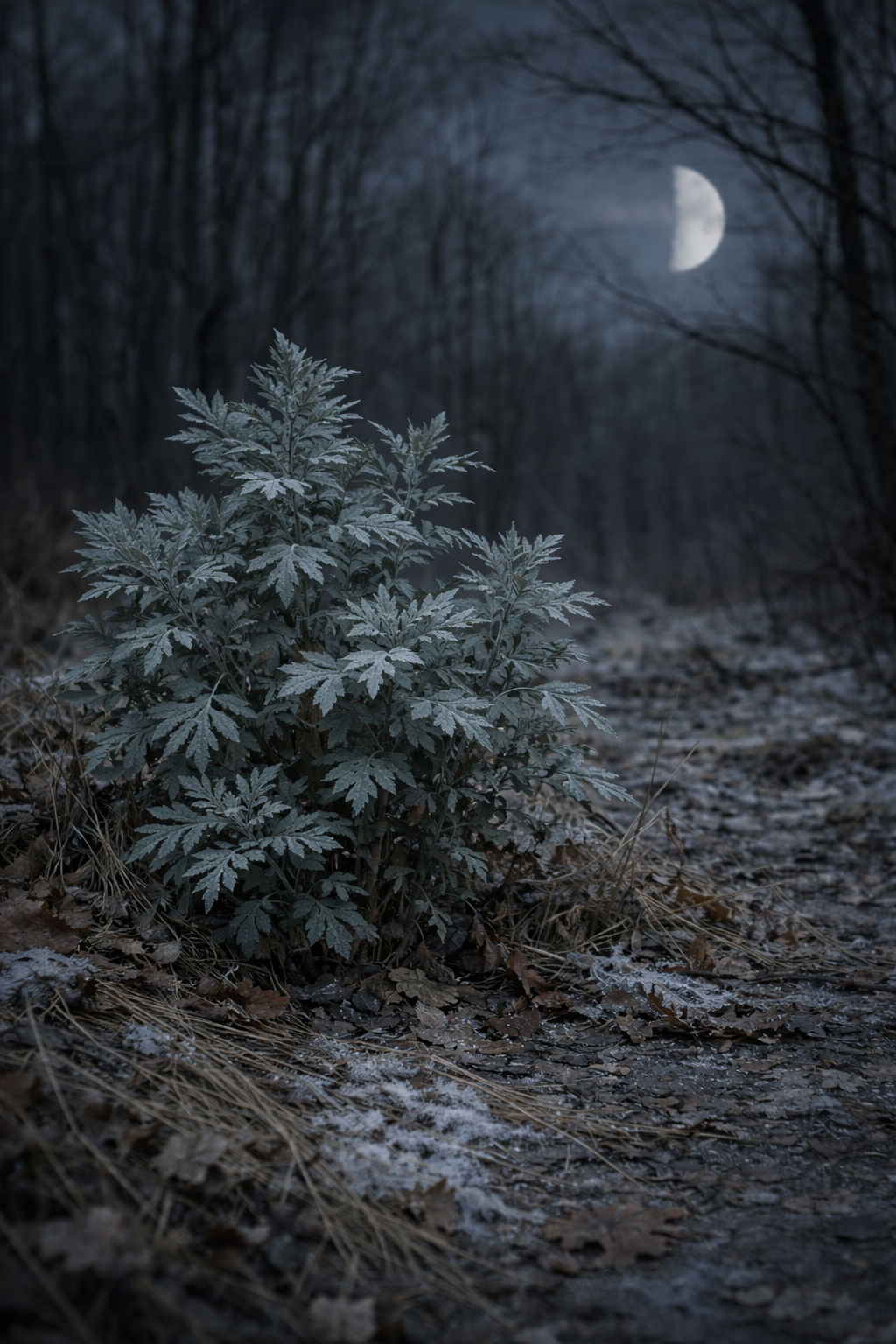
Mugwort Profile
Botanical names:Artemisia vulgaris (common Mugwort); Artemisia douglasiana (Douglas Mugwort / California Mugwort); Artemisia glacialis (Alpine Mugwort); Artemisia norvegica (Norwegian Mugwort); Artemisia suxdorfi (Pacific Northwest coastal Mugwort); Artemisia tridentata (desert Mugwort; commonly called “sage,” though botanically unrelated)
Family: Asteraceae
Common names: Mugwort, Common Mugwort, Felon Herb, Cronewort, Motherwort, Chrysanthemum Weed, Sailor’s Tobacco
Additional names: Chinese Honeysuckle, California Mugwort, St. John’s plant, Ay Yi (Chinese Medicine; interchangeable with Artemisia argyi), Moxa
Parts used: Aerial parts (leaf and flowering tops), root
Energetics: Warm, dry, bitter, aromatic
Primary affinities: Nervous system, uterus, dreaming, perception, threshold
Actions: Nervine, emmenagogue, aromatic bitter, oneirogen, vulnerary
Mugwort is aromatic, bitter, and warming, with a marked affinity for the nervous system, circulation, and reproductive organs. Her volatile oils contribute to her effects on perception, movement, and orientation within altered states, while her bitterness supports digestion and hepatic (liver) flow. She has long been associated with liminal states, both physiological and symbolic.
On Formulation and Ingredient Integrity
Formulation is the art of relationship. An herbal formula is not a collection of ingredients but an architecture, designed to support a specific pattern of need. The formulas presented here assume the use of properly prepared tinctures for each herb involved. This matters because extraction determines which constituents are present and available to the body.
In multi-herb formulas, consistency of preparation allows the practitioner to understand how each plant is contributing to the whole. When preparations vary widely in strength or chemical profile, the conversation between herbs becomes indistinct. The logic of formulation depends on clarity at the level of ingredients.

Mugwort as Smoke
Breath, Threshold, and Relationship
Smoke has long been used across cultures as a carrier and a bridge. When an herb is burned, its material body is transformed into something that rises, moves, and enters the breath. Smoke is breath made visible, linking the tangible and the unseen.
Inhaling smoke unites the herb’s volatile constituents with the human breath, allowing the relationship to enter the body quickly and directly. This method has traditionally been used at thresholds—before ceremonies, during transitions, in moments of grief or vision—because it shifts perception and marks space as intentional. When smoke is inhaled, the body itself becomes part of that marked space.
Working with a plant in this way is intimate. The plant is taken into the lungs, blood, and brain, creating a direct alliance. Each plant carries its own character and function within this context, whether for protection, vision, guidance, or release. Mugwort’s aromatic profile lends itself to this work, supporting shifts in awareness and engagement with dreaming and visions.
In practice, effective smoking blends rely on a structural backbone—herbs that are dry, fibrous, and aromatic enough to carry combustion—supported by softer herbs that shape tone and experience. In this way, the mechanics of burning and the energetics of dreaming work together rather than at odds.
Mugwort plays a central role here. Her aromatic oils, dry leaf structure, and long-standing association with dream-vision make her well suited to inhalation work. When paired with complementary herbs that support breath, sustain burn, and shape tone, smoke functions as a means of reorientation, shifting how attention is held and how perception organizes itself as the body moves toward sleep.
In my own practice, I burn a small amount of dried Mugwort in a bowl by the bed before sleep or I use a dry herb vaporizer as it allows for a gentler, more controlled delivery of aromatic compounds. The essential relationship remains between plant, breath, and perception.
Lucid Dreaming Smoke Blend
This smoking blend is structured to support lucid dreaming through clarity and sustained perceptual engagement rather than sedation. Mugwort and Damiana form the aromatic and combustion backbone, allowing the blend to carry consistently and meet the nervous system without collapse. Mullein supports breath and even distribution, while Passionflower and Blue Lotus shape the quality of dreaming, softening internal boundaries without dulling awareness. The result is a blend oriented toward lucidity as continuity of consciousness, rather than intensity.
30% Mugwort leaf (Artemisia vulgaris)
20% Damiana leaf (Turnera diffusa)
20% Mullein leaf (Verbascum spp.)
15% Passionflower aerial parts (Passiflora incarnata)
15% Blue Lotus petals (Nymphaea caerulea)
Mugwort in Tincture
Formulation Expressions
When Mugwort is incorporated into tincture formulas, her role emerges through relationship with other herbs and with the person taking them. The following formulations illustrate how one herb participates in different expressions depending on constitution, purpose, and formulation partners. Percentages are offered to illustrate formulation logic rather than to prescribe use.
Lucid Dreaming Formula
This formula is oriented toward supporting conscious awareness during sleep while allowing the body to rest. Mugwort provides the aromatic and liminal foundation, engaging the dreaming mind and supporting continuity of awareness.
25% Mugwort leaf (Artemisia vulgaris)
25% Guayusa leaf (Ilex guayusa)
10% Passionflower leaf and flower (Passiflora incarnata)
10% Lavender flower (Lavandula angustifolia)
10% Lotus leaf (Nelumbo nucifera)
10% Rosemary leaf (Rosmarinus officinalis)
10% Ginkgo leaf (Ginkgo biloba)
Guayusa, traditionally used among the Shuar people of Ecuador in dreaming practices, contributes clarity and alert presence when used in small, tinctured amounts. A trio of nervines—Passionflower, Lavender, and Lotus leaf—soften the nervous system and ease the transition into sleep without dulling perception. Rosemary and Ginkgo support cerebral circulation, assisting with clarity, focus, and memory recall, helping to remember upon awakening.
Together, these herbs create a formula that supports lucidity as a state of coherence rather than stimulation.
Cyclical Stagnation & Tension
(Kapha Constitution)
This formulation addresses patterns of heaviness, stagnation, and tension commonly associated with Kapha constitutions during cyclical shifts. The emphasis here is on movement, warmth, and rhythmic flow.
25% Chaste Tree Berry (Vitex agnus-castus)
15% Motherwort aerial parts (Leonurus cardiaca)
15% Mugwort leaf (Artemisia vulgaris)
15% Yarrow aerial parts (Achillea millefolium)
15% Angelica root (Angelica archangelica)
15% Valerian root (Valeriana sitchensis)
5% Ginger rhizome (Zingiber officinale)
Yarrow, Angelica, and Ginger provide circulatory stimulation and digestive support, encouraging the movement of blood and energy. Motherwort and Mugwort contribute antispasmodic and nervine qualities, easing tension and supporting uterine and emotional rhythm. Valerian is included in modest proportion for its warming, relaxing effects, which can be appropriate for Kapha constitutions when used thoughtfully.
The formula works through engagement and circulation, supporting release rather than suppression.
Nervous System Restoration Triplet
(after David Hoffmann)
This is a restorative formula designed to nourish the nervous system over time. St. John’s Wort offers trophic support and gentle uplift, while Milky Oats provide deep nourishment to depleted nerves.
50% St. John’s Wort flowering tops (Hypericum perforatum)
25% Milky Oats fresh seed tops (Avena sativa)
25% Mugwort leaf (Artemisia vulgaris)
Mugwort’s role in this formula is aromatic and dispersive, assisting in the movement of the other constituents through nervous tissue. Her presence supports integration rather than dominance, helping the formula act as a coherent whole.
This formulation is oriented toward resilience and gradual restoration.
Attunement
Mugwort teaches through pattern and relationship. Her medicine becomes intelligible when we attend to constitution, formulation, timing, and method of use. Working with her well requires attunement—a willingness to observe how an herb meets the body and psyche across different moments, without forcing it into a single story.
This is the nature of plant medicine: meeting the plant in practice, adjusting through experience, and allowing understanding to deepen through time.
In devotion,
Alexandra Regina
Black Fox Lunar Apothecary
Vitalist Herbal Practitioner